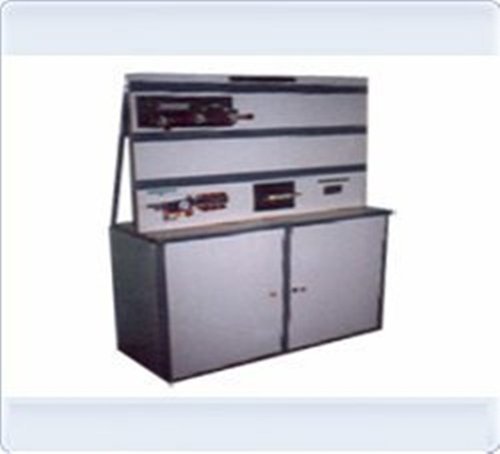
About Basic Pneumatic Trainer
Basic Pneumatic Trainer
| Usage/Application |
Laboratory |
| Voltage |
220-240 V |
| Material |
Mild Steel |
| Brand |
Micro Technologies |
| Frequency |
50 Hz |
| Phase |
Single Phase |
| Surface Finish |
Powder Coated |
| Pressure Gauge |
70 bar |
| Oil Tank Capacity |
30L |
| Motor Power |
1 Hp |
Comprehensive Hands-On LearningDesigned for practical demonstration, the pneumatic trainer enables students to assemble circuits, simulate industrial processes, and troubleshoot real-world pneumatic systems. Multiple experiments, including logic, sequencing, and control using different valves, can be performed. Its modular structure ensures adaptability for varied educational requirements.
Robust and Safe ConstructionWith a powder-coated steel frame and an ABS panel, the trainer offers long-lasting durability. Safety is prioritized through features such as the inline pressure relief valve and emergency stop switch, ensuring secure operation during demonstrations and training sessions.
Flexible Applications and Modular DesignThe trainer is suitable for a range of educational levels, including ITI, Polytechnic, Engineering, and Vocational Institutes. Its modular setup and table-mounted configuration allow for easy adjustment and customization, supporting multiple basic pneumatic experiments as per curriculum needs.
FAQ's of Basic Pneumatic Trainer:
Q: How is the Basic Pneumatic Trainer used in educational settings?
A: It is deployed in ITI, Polytechnic, Engineering, and Vocational Institutes for hands-on skill training. Students use it to assemble pneumatic circuits, troubleshoot faults, and perform industrial process simulations, enhancing practical understanding of pneumatic systems.
Q: What components are included with the pneumatic trainer?
A: The trainer includes single and double acting cylinders, 3/2 and 5/2 pneumatic valves, an FRL unit, pressure gauges, hoses, fittings, an aluminum panel with a mounting grid, and essential safety provisions like a pressure relief valve and emergency stop switch.
Q: When should instructors utilize the trainer during coursework?
A: Instructors typically use the pneumatic trainer during lab sessions or practical classes where circuit design, logic implementation, troubleshooting, and process simulation are being taught, allowing immediate real-world application of theoretical concepts.
Q: Where can the trainer be installed for demonstrations?
A: As a tabletop equipment type, it is best installed in laboratory classrooms, workshops, or training centers where workspace and access to power supply (230V AC, 50Hz) are available.
Q: What is the typical process for assembling and operating a pneumatic circuit on this trainer?
A: Users mount components onto the panel grid, connect hoses and fittings, and assemble circuits as per the experiment module. Operation is manual, with users adjusting valves and monitoring gauges for instant feedback.
Q: What benefits does the pneumatic trainer offer to students?
A: It provides experiential learning, allowing students to gain hands-on proficiency in setting up, analyzing, and troubleshooting basic pneumatic systems, which is essential for careers in automation and industrial technology.
Q: How does the safety provision enhance the learning experience?
A: Features like the inline pressure relief valve and emergency stop switch protect users during experiments, promoting safe practice and risk-free demonstrations, while fostering confidence in operating pneumatic equipment.







 Send Inquiry


 Send Inquiry


 English
 Spanish
 French
 German
 Italian
 Chinese (Simplified)
 Japanese
 Korean
 Arabic
 Portuguese